Concentrations
 Click logo to return to 'links-page'
2009 - The charge was made recently that the C&C Proposal, "does not stipulate the speed at which it must occur, which is clearly the central question to be answered."
It is the central question to be answered but the charge does not stick. Over the last twenty years, GCI has arguably made more effort than any other agency in the entire UNFCCC-process to elucidate, answer and communicate answers to this point about the rates of C&C that are required for UNFCCC-compliance and so show how negotiators at the UNFCCC can be assisted to come to an effective global agreement. This inevitably requires solving the problem faster than we are creating it - quite a challenging thing to conceive and to communicate and certainly a challenging thing to achieve.
A few examples of GCI's efforts on this question follow
NB the analysis animation immediately was present to the EAC Enuiries in 2009.
Viewing this the UKMO, claimed that GCI did not undertand the carbon cyle.
However, it simply illustrates what is in UKMO's spread sheets of the UK Climate Act.
So if a lack of understanding is the issue, they were taking issue with their own work.
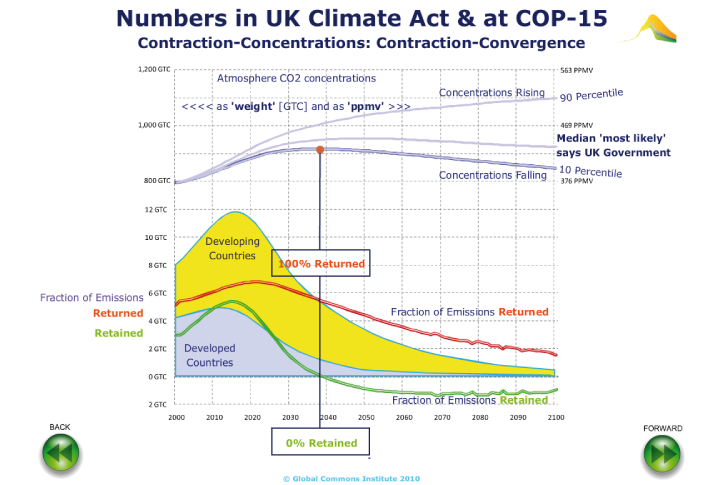
Presentation/animation: An assessment of 'Contraction & Concentrations' and 'Contraction & Convergence' and the C&C targets and modelling behind various rates of 'sink-efficiency' in the UK Government's 'Climate Act' [2008]. Also for 'download and save' as a self-executing PC file here
*************************************************************
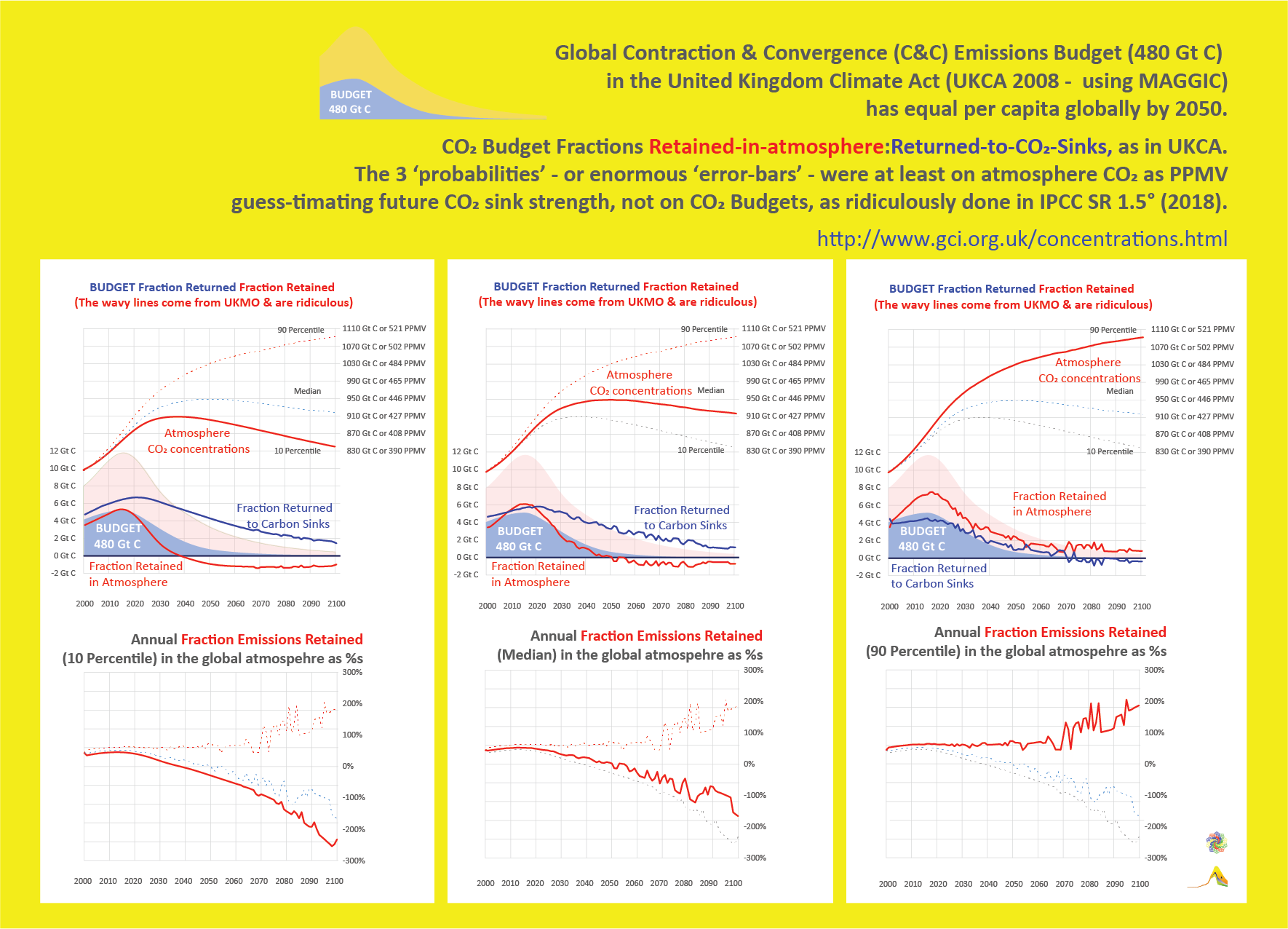
Spreadsheet based on Government spreadsheets with GCI Chart visible below: - added 2020The methodology for weighing concentration-projections & comparing these with the carbon-budget is straightforward
- take concentrations shown as PPMV in the spreadsheet provided with the Act
- convert these to weights (1 PPMV weighs 2,13 Billion Tonnes Carbon) to compare with budget weights
- from each year deduct the weight of the previous year, to show annual change difference
- convert to percents and multiply budget by these data-streams to get streams for the
[a] budget-fractions-returned to sinks &
[b] budget-fractions retained in atmosphere
*************************************************************
The '50:50' odds the UK Government gave for avoiding a temperature rise globally of more than two degrees with their emissions scenario are examined in this context. A letter (08 06 2010) from eminent persons sent to the UK Secretary of State for Energy and Climate Change about these matters is here
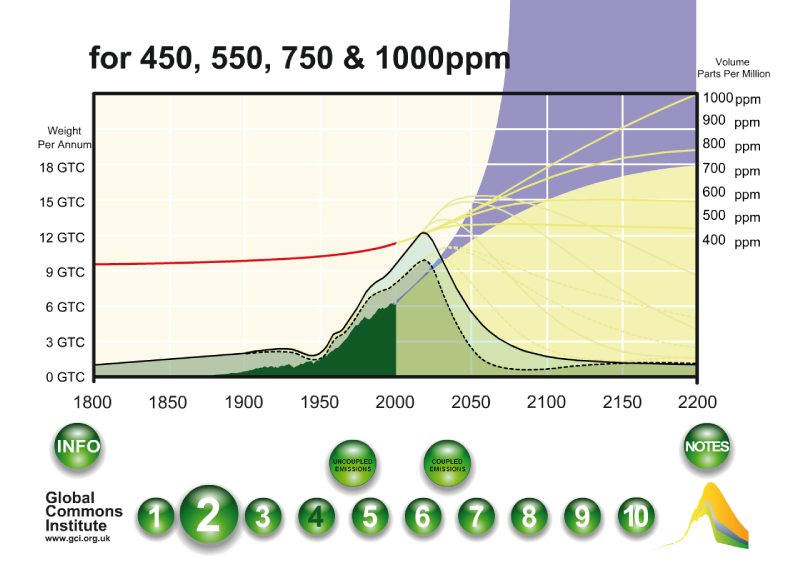
Presentation/animation puts C&C in the context of IPCC AR4 [2007] and the so-called 'coupled-carbon-cycle' modelling reported quantitatively for the first time since IPCC FAR 1990. Essentially, due to 'positive feedback' effects in the carbon cycle, where rising temperature amplifies the rate at which atmospheric GHG concentration increases, accelerated rates of carbon emissions contraction are needed to meet a given concentration outcome. This is the increasingly crucial issue of changing rates of 'Sink-efficiency'. In depth analysis of this in relation to the UK Climate Act is here.
Presentation/animation: used at the RIBA Summit [2006] Venice.
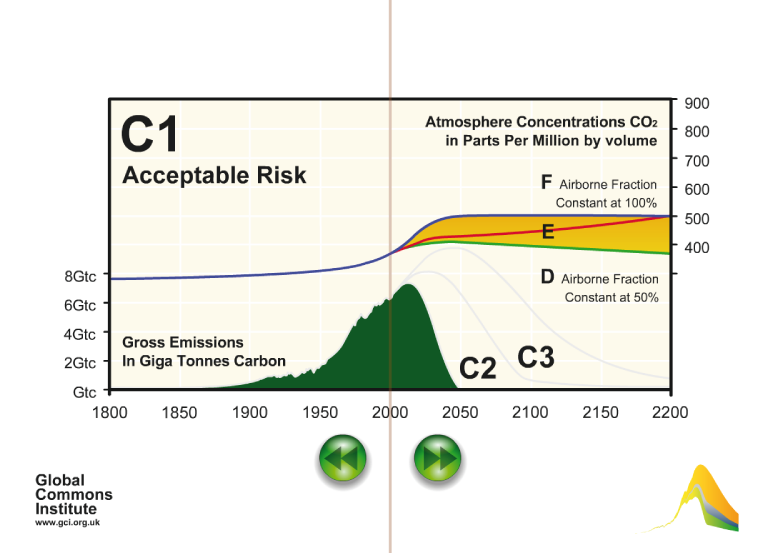
In the context-overview at: - Acceptable Dangerous Impossible Risk overview, the Acceptable [C1] Dangerous [C2] Impossible [C3] Rates of C&C animated here and this supports the short article at: - Climate Action book 2007 C&C discussed in more detail here: - C&C_Chapter_Levene_Book_.pdf
Presentation/animation: used at the RIBA Summit [2006] Venice.
In the context-overview at Acceptable Dangerous Impossible Risk
the Acceptable [C1] Dangerous [C2] Impossible [C3] Rates of C&C
animated here and this supports the short article
Climate Action book 2007 C&C discussed in more detail here
The rates for Contraction:Concentrations and Contraction:Convergence
are compared in this animation as: -Acceptable [C1]
Dangerous [C2]
Impossible [C3]Rates of C&C at four different theoretical rates of sink-failure.
A few more examples of GCI's effort ranging over the last fifteen years follow: -
http://www.gci.org.uk/animations/C&C_COP_15.swf
http://www.gci.org.uk/animations/C1_C2_C3_animations.exe
http://www.gci.org.uk/animations/C1,C2,C3.swf
http://www.gci.org.uk/C&C_Animation.exe
http://www.gci.org.uk/Documents/C&CSlideshow_notes.pdf
http://www.gci.org.uk/movies/Contraction_and_Convergence_Challen_et_al.flv
http://www.gci.org.uk/movies/Contraction_and_Convergence_Risk_Analysis_Sink_Failure.flv
http://www.gci.org.uk/Documents/CPI.pdf
http://www.gci.org.uk/Documents/C&C_Chapter_Levene_Book_.pdf
http://www.gci.org.uk/briefings/RSA_Occasional_Paper.pdf
http://www.gci.org.uk/Documents/ASEF_.pdf
http://www.gci.org.uk/Documents/Korea_C&C_Notes_for_Jeju_.pdf
http://www.gci.org.uk/Documents/PIU.pdf
http://www.gci.org.uk/Documents/UNEPFI_a.pdf
http://www.gci.org.uk/animations/BENN_C&C_Animation.exe
http://www.gci.org.uk/Documents/Benn_DEFRA_15_11_07_.pdf
http://www.gci.org.uk/Documents/ASEF_.pdf
http://www.gci.org.uk/Documents/Korea_C&C_Notes_for_Jeju_.pdf
http://www.gci.org.uk/Documents/PIU.pdf
http://www.gci.org.uk/Documents/UNEPFI_a.pdf
This record is variously recognized: -
http://www.gci.org.uk/endorsements.html
http://www.gci.org.uk/endorsements_UN_Bodies.html
http://www.gci.org.uk/endorsements_UK_Climate_Act.html
http://www.gci.org.uk/endorsements_institutions.html
http://www.gci.org.uk/endorsements_medics.html
http://www.gci.org.uk/endorsements_religious.html
http://www.gci.org.uk/endorsements_population.html
http://www.gci.org.uk/endorsements_ethics.html
http://www.gci.org.uk/endorsements_equity_fairness.html
http://www.gci.org.uk/endorsements_sustainability.html
http://www.gci.org.uk/endorsements_sceptics.html
http://www.gci.org.uk/endorsements_campaigns.html
http://www.gci.org.uk/endorsements_sociology.html
http://www.gci.org.uk/endorsements_academia.html
http://www.gci.org.uk/endorsements_capitalist_socialist.html
http://www.gci.org.uk/endorsements_law.html
http://www.gci.org.uk/endorsements_economists.html
http://www.gci.org.uk/endorsements_politics.html
http://www.gci.org.uk/endorsements_justice_eco_debt.html
http://www.gci.org.uk/endorsements_publications.html